Recursos en Español
Para encontrar recursos de ASERT que han sido traducidos al español, haga clic aquí.
To find ASERT resources that have been translated into Spanish, click here.
Para encontrar recursos de ASERT que han sido traducidos al español, haga clic aquí.
To find ASERT resources that have been translated into Spanish, click here.
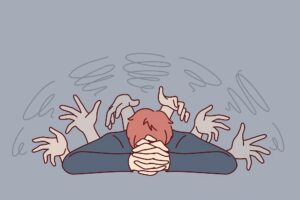
The brain uses tiny chemical messengers to pass signals from one nerve cell to the next. These messengers are called neurotransmitters. Two of them matter most in catatonia: glutamate and GABA.
Most of the time, they work as a team, and the brain runs smoothly. In catatonia, the brain makes less GABA, and we do not fully know why. Glutamate then takes over.
Picture a city where every traffic light turns green at once. At first, cars zoom down the main roads. The side streets cannot move at all. Soon every street is jammed, and nothing moves. The same kind of jam happens in the brain.
Catatonia often starts with a lot of movement that has no purpose. The person may seem restless or upset and may do more stimming than usual. They may get stuck on one idea or one activity and have trouble moving on. Everyday jobs like getting dressed and showering get harder. As catatonia gets worse, the person may:
A mental health provider diagnoses catatonia. They look at the person’s past health and what is going on now. They also ask which medicines the person takes. Doctors use checklists called scales to see how likely it is that the person has catatonia.
The main goal is to raise GABA in the brain. There are a few ways to do this.
Medicine. The first choice is usually a benzodiazepine. The two most common are lorazepam (Ativan) and clonazepam (Klonopin). Doctors also use these medicines as a test. If the person gets better, it was probably catatonia. The dose for catatonia is much higher than the usual
dose for other problems. Even so, most people do not feel sleepy or groggy. Some people feel much better after the very first dose.
Medicines to cut back or stop. Antipsychotic medicines can make catatonia harder to treat. Examples are risperidone (Risperdal), quetiapine (Seroquel), and Lurasidone (Latuda). The doctor will tell you how to handle these medicines. Never stop a medicine without asking the doctor first. Other medicines. Some people do not do well on benzodiazepines. Researchers are studying other medicines, and the doctor may suggest one if the research supports it.
ECT. If medicine does not work well enough, doctors may suggest ECT (electroconvulsive therapy). Many people feel scared when they hear this. ECT is safe and works well. Doctors have used it for many years.
Doctors still have a lot to learn about catatonia, so it is hard to say if it will come back. Having it once makes it more likely to happen again. Some people only have it one time.
If it does come back, there are good ways to manage it:
The main goal of treating catatonia is to increase a brain chemical called GABA, which helps the brain work properly. This resource gives general information about treatment options for catatonia. It is not medical advice.
The most common medicines used to treat catatonia are called benzodiazepines. These medications are usually safe and work well for many people. About 60% to 90% of people with catatonia improve when treated with these medications.
If a doctor thinks someone may have catatonia but is not sure, they may use a benzodiazepine challenge. This means giving the medication for a short time to see if symptoms improve. If there is improvement, it suggests that catatonia is present and that the medication is likely to help.
The doctor may need to adjust the dose to find what works best. This usually requires very high doses of these medications. If symptoms do not improve enough with medication, other treatments may be considered.
If medication does not help enough, ECT may be recommended. ECT is a safe and effective treatment that is done in a hospital or other medical setting.
During ECT, the person is asleep under anesthesia. A small, carefully controlled electrical current is sent to the brain. This causes a brief seizure that can help reset the way the brain’s chemicals and signals work.
ECT is usually given in a series of treatments. Most people receive treatment two to three times a
week for several weeks. As symptoms improve, treatments may be spaced farther apart. Some people continue with maintenance treatments about once a month to prevent symptoms from returning.
Behavioral supports should be used along with medical treatments. Catatonia is a medical condition, not a behavior problem. Even though some symptoms may look like challenging behavior, they are caused by changes in the brain. Helpful supports may include:
Getting treatment quickly is important for two reasons.
Treatment for catatonia usually includes medicine first. Many people get better, but some do not improve enough. When medicine is not enough, electroconvulsive therapy (ECT) may be the next treatment option. ECT is safe and works well. Deciding to try ECT can feel like a big step. It is okay to ask questions and take time to understand the plan. The goal is to help the person feel better, do more, and get back to the activities and relationships that matter most to them. This resource provides an overview of ECT and what to expect if it’s recommended as a treatment option.
During ECT, a doctor sends a small, carefully controlled electrical current to the brain while the person is asleep under anesthesia. This causes a brief seizure that can help reset the way the brain’s chemicals and signals work.
The person does not feel the seizure and usually does not remember the treatment after.
ECT is given in a series of treatments. Most people have sessions two to three times a week for
several weeks.
As the person improves, the treatment may be reduced to twice a week, then once a week. People with autism and catatonia may need more treatments than catatonia patients without autism. Some improve after 10 to 12 treatments. Others may need 30 or more before feeling better.
There are important safety steps before ECT can begin. These steps help make sure ECT is needed and can be done as safely as possible.
| Name | Description | Type | File |
|---|---|---|---|
| Catatonia in Autism | This resource explains what catatonia is. | Download file: Catatonia in Autism | |
| Treatment Options for Catatonia | This resource explains the different treatment options that exist for catatonia. | Download file: Treatment Options for Catatonia | |
| Electroconvulsive Therapy (ECT) for Catatonia | This resource explains what ECT is and how it is used to treat catatonia in autistic individuals. | Download file: Electroconvulsive Therapy (ECT) for Catatonia |
This information was developed by the Autism Services, Education, Resources, and Training Collaborative (ASERT). For more information, please contact ASERT at 877-231-4244 or info@PAautism.org. ASERT is funded by the Bureau of Supports for Autism and Special Populations, PA Department of Human Services.