Hide messageView More

Recursos en Español

Para encontrar recursos de ASERT que han sido traducidos al español, haga clic aquí.
To find ASERT resources that have been translated into Spanish, click here.

Quick links: MyODP ASDNext AidInPA PhillyAP

Supportive Technology

Terms and Definitions

Overview

There are many different terms that are used when talking about supportive technology which can make it confusing to tell the difference between different services and supports. This guide provides an overview of some common terms and examples related to supportive technology.
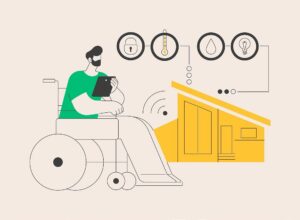
A man in a wheelchair holding a tablet. The tablet is used to control home adaptions and assistive technology for people with disabilities.

    • Supportive Technology: Supportive technology is any device, software, or system that increases independence, communication, and daily functioning. This technology is for individuals with disabilities or older adults. Supportive technology does not have to be electronic; it can also be a “low-tech” system that supports the individual. Supportive technology can also be referred to as Assistive Technology or Independent Living Technology.

Example:

John uses a stove sensor that sends a text alert to his phone when the stove has been turned on for longer than 30 consecutive minutes. Jill uses pictures of food to make her grocery list for the week on a Velcro “notepad.”

    • Remote Supports: Remote supports are digital tools or virtual services that connect a person with disabilities with a support person. The support person can provide real-time guidance or monitoring through text or communication apps like FaceTime, Messenger, or Zoom, or another similar platform. This can include telemedicine or telehealth appointments.

Example:

John uses a stove sensor that is monitored by a direct support professional who is offsite. The direct support professional calls John when the stove has been on for longer than 30 consecutive minutes and checks to see if he needs help. Jill has camera and intercom technology on the front and back doors. When the door opens, staff are alerted and can view activity and interact with Jill or other visitors.

    • Home Accessibility Modifications: Home adaptations are changes to the structure of the house or device installations in a home. These ensure health, safety, and independent living for individuals with physical limitations, aging needs, or disabilities.

      Changes range from simple, low-cost adjustments (like removing throw rugs or replacing round doorknobs with lever handles) to major structural updates (such as widening doorways or installing wheelchair ramps).

Example:

John’s home has motion-sensor lights to support his low-vision needs. Jill has grab bars and seating installed in the shower, as she is experiencing frequent dizziness due to her POTS diagnosis.

    • Vehicle Modifications: Vehicle modifications are changes made to a car or van that make it possible for a person with a disability to be a passenger and/or a driver. Examples include adding a left-side accelerator pedal, modifying it for hand controls or adaptive steering, or making accommodations for wheelchair accessibility.

Example:

Kristin has hypermobility in her lower body and uses a swivel seat to help her enter and exit her vehicle pain-free.

    • Smart Home Technology: Smart home technology is a setup of internet-connected devices that lets you control and automate household systems remotely using a phone or voice assistant. This includes lighting, heating, and security. These devices are part of the Internet of Things (IoT), meaning they can share data and respond to your daily routines.

Example:

Lawson struggles to tolerate extraneous noises and often wears his headphones in the house. His house has technology that flickers the lights when the doorbell or phone is ringing.

    • Adapted Technology: Adaptive technology is a specialized subset of assistive technology explicitly designed, modified, or tailored to help individuals with disabilities perform tasks that might otherwise be difficult or impossible. Adapted technologies include keyboard filters/modifications, prosthetic limbs, eye-tracking systems, and wheelchair modifications such as specialized cushions, wheels, or attached screens and controls.

Example:

Jasmine uses speech-to-text to send emails and text messages because she does not spell/read.

    • Customization: Customization is when something is changed or specifically made to meet the needs of a task or a person with a disability. Customization can be applied to almost all the supportive technology described above. Customization allows individuals to have the tools that work, help, or fit the best for them. This makes everyday life easier and improves their functional capabilities.

Example:

As Charlie increases his literacy skills, the text on his communication device is enlarged, and the picture icons are made smaller to meet his skill level.

Rate this resource

Thank you for rating this resource!

Download entire resource (pdf)

This information was developed by the Autism Services, Education, Resources, and Training Collaborative (ASERT). For more information, please contact ASERT at 877-231-4244 or info@PAautism.org. ASERT is funded by the Bureau of Supports for Autism and Special Populations, PA Department of Human Services.