Recursos en Español
Para encontrar recursos de ASERT que han sido traducidos al español, haga clic aquí.
To find ASERT resources that have been translated into Spanish, click here.
Para encontrar recursos de ASERT que han sido traducidos al español, haga clic aquí.
To find ASERT resources that have been translated into Spanish, click here.

Un trauma es un suceso o evento que ocurre y puede afectar a las personas de diferentes maneras.
Los traumas pueden ocurrir por cosas como:
Las personas pueden sufrir traumas de manera directa. Un ejemplo de trauma directo es cuando alguien sufre un accidente.
Si alguien ve como le pasa algo a otra persona, eso podría causarle un trauma. Un ejemplo de esto es verque alguien sufre un accidente.
Oír el relato de un trauma que le ocurrió a otra persona puede causarle un trauma a la persona que escucha ese relato. Un ejemplo de esto es si alguien le cuenta a una persona los detalles de un accidente que ocurrió.
A veces puede ocurrir un trauma en el trabajo, por ejemplo, un policía o un bombero pueden sufrir un trauma en su trabajo.
Algunas personas son afectadas por el trauma en el momento mismo en que ocurre el evento que lo causa.
Otras personas podrían no sentir los efectos del trauma hasta después de transcurridos días, semanas o meses.
Hay personas que se sienten afectadas por el trauma inmediatamente y siguen sintiéndose así durante días, semanas o meses.
Los traumas pueden afectar numerosas áreas de la vida de las personas.
Algunas de las áreas que pueden verse afectadas son:
Los traumas y eventos traumáticos pueden producirse de muchas maneras diferentes . Abajo se presentan algunas definiciones y ejemplos de cómo pueden ocurrir los traumas .
Evento único: Este tipo de trauma se produce una sola vez, por ejemplo, un accidente de automóvil.
Evento crónico: Este tipo de trauma cons is te en una serie de eventos que ocurren a lo largo de un tiempo determinado, por ejemplo, la pandemia de la COVID.
Trauma del desarrollo: Este tipo de trauma ocurre en la niñez temprana. Por lo general, es crónico. Un ejemplo de es te tipo de trauma es tener cáncer a los 5 años de edad y pasar muchos meses hospitalizado.
Trauma en una relación: Este tipo de trauma es causado por alguien con quien tienes una relación. Un ejemplo de es te tipo de traumas es sufrir abusos fís icos de un padre, una madre o un(a) cuidador(a).
Trauma complejo: Este es el tipo de trauma que sufre una persona que ha vivido muchos tipos dis tintos de eventos traumáticos . Un ejemplo de es te tipo es alguien cuyos padres se divorciaron cuando era pequeño, vio cómo un miembro de su familia sufría un accidente automovilís tico grave y sufrió abusos por parte de una persona que lo cuidaba cuando era adolescente.
Trauma intergeneracional: En este caso, las respues tas al trauma son transmitidas de una generación a otra por las personas que sufrieron un trauma. E s to puede incluir un trauma que afecta a una sola persona, a varios miembros de una familia o a una comunidad entera. E jemplos de es te tipo de trauma son la esclavitud y el Holocaus to.
Las personas s ienten y afrontan los traumas de manera diferente.
Dos personas pueden sufrir el mismo trauma y, sin embargo, responder de manera diferente. Algunas personas podrían mostrar signos de estrés traumático, mientras que otras podrían manifes tar pocos indicios o ninguno.
Las personas pueden responder a los traumas de manera diferente dependiendo de su edad. Los niños que pasan por un evento traumático podrían mojar la cama, apegarse más a su madre, a su padre o a la persona que los cuida, o representar el evento traumático cuando están jugando.
Los adolescentes pueden actuar de manera grosera, ser descons iderados o tomar decisiones que no son sanas . Los adultos podrían sentirse enfadados , evitar a los demás o actuar de forma agresiva consigo mismos o con los demás .
Estos son algunos indicios de que una persona puede haber experimentado un evento traumático:
Cuando alguien experimenta un trauma, puede provocarle estrés traumático.
Se puede experimentar un trauma cuando:
El trastorno de estrés postraumático es el diagnóstico que recibe alguien que experimentaun trauma y desarrolla síntomas que le dificultan funcionar en su vida diaria.
El estrés postraumático puede causar síntomas como:
Los traumas afectan a cada persona de manera diferente. No todas las personas que experimentan un trauma son diagnosticadas con el síndrome de estrés postraumático.
Si experimentas un evento traumático, podrías tener todos, algunos o ninguno de los síntomas de estrés postraumático.
El circuito de sobrevivencia es cómo responden nuestro cuerpo y nuestrocerebro a las amenazas que nos rodean. Nuestro cerebro está diseñado pararesponder de esta manera con el fin de ayudarnos a sobrevivir a lasamenazas y el estrés.
El circuito de sobrevivencia es cómo responden nuestro cuerpo y nuestrocerebro a las amenazas que nos rodean. Los traumas pueden modificar la forma en que funciona el circuito de sobrevivencia en nuestro cerebro.
Cuando tu cerebro cree que estás frente a una amenaza, envía señales a tu cuerpo para que reaccione con el fin de mantenerte a salvo. Esto sucede cuando existe un peligro real, pero también si tú crees que hay un peligro aunque no sea verdad.
Cuando tu cerebro cree que existe una amenaza, tu cuerpo puede reaccionar de varias maneras distintas. Estas reacciones a veces se denominan “las 4 F”, porque en inglés todas comienzan con esa letra y así es más fácil recordarlas.
Las personas sensibles a los traumas entienden que el trauma puede afectar a la gente de muchas maneras distintas.
Aprendemos que la gente sufre independientemente de que conozcamos o no el motivo exacto y, sin embargo, tratamos de entenderlo. Por eso, es importante buscar en el comportamiento de una persona las señales que podrían ser resultado de una experiencia traumática.
Una persona sensible a los traumas nunca le preguntaría a alguien “¿qué hiciste?” sino, más bien, “¿qué te pasó?”. Las personas sensibles a los traumas entienden que no hay que responsabilizar a la víctima y que el trauma que ella experimenta no es su culpa.
Ser resiliente significa tener la habilidad para recuperarnos cuando nos sucede algo malo.
Podemos aprender nuevas habilidades de resiliencia que nos permitan afrontar los problemas de manera sana, así como también encontrar maneras de reducir el sufrimiento.
Ser sensible a la resiliencia también significa ser conscientes de que cualquiera podría estar lidiando con un trauma. Una persona sensible a la resiliencia nunca preguntaría “¿qué hiciste para que te pasara eso tan malo?”, sino, más bien, “¿en qué cosas te va bien?” y “¿cuáles son tus puntos fuertes?”.
Los proveedores de cuidado sensibles a los traumas tienen que saber lo que les ha pasado a sus pacientes y cómo les ha afectado. Eso les permitirá proporcionar el tipo de cuidado específico que consideren mejor para cada persona a la que tratan.
Este tipo de cuidado ayuda a las personas a recuperarse y sanar. Les permite encontrar nuevos propósitos y tener una vida plena y significativa aun después de haber experimentado un trauma. Cuanto mejor sea el cuidado que reciban las personas, más resilientes se volverán.
El cuidado sensible a los traumas a menudo se acompaña con terapia sensible a la resiliencia. Este es un tipo de terapia que permite a las personas superar su trauma. También les ayuda a ser más resilientes y a aprender nuevas habilidades.
This resource visually explains how trauma can affect sleep.
View ResourceThis resource, part of the Be Safe resource collection focused on the prevention of sexual abuse and assault, provides information in a visual format on what is trauma.
View ResourceLa resiliencia se puede explicar de muchas maneras distintas. También puede significar distintas cosas. ¡Todas las personas
tienen resiliencia!
Cuando hablamos de resiliencia, nos referimos a mantener la calma y a no perder el control cuando enfrentamos un desafío.
La resiliencia es importante porque proporciona a las personas una manera entender el trauma y de superar tiempos difíciles.
Ser resiliente significa que eres lo suficientemente fuerte para poder:
Las personas menos resilientes pueden recurrir a maneras poco sanas para superar los tiempos difíciles.
Ser resiliente, o tener resiliencia, significa ser capaz de afrontar un problema y recuperarte rápidamente.
La resiliencia hace que las personas sean flexibles cuando les pasa algo. Les permite pensar en lo que les sucedió y aprender cómo cambiar, responder y sanar.
La resiliencia es importante porque ayuda a las personas a afrontar las cosas malas que les pasan. Eso significa que las personas resilientes son lo suficientemente fuertes para recuperarse de situaciones difíciles. Por ejemplo: Traumas, enfermedad, desastres, quedarse sin trabajo, fallecimiento de un ser querido, la pandemia del COVID-19, etc.
INos permite gestionar las cosas de manera sana y regresar al camino en el que estábamos antes. Tener que afrontar situaciones difíciles puede afectar nuestras rutinas, nuestra salud mental o física, la imagen que tenemos de nosotros mismos, nuestras relaciones y muchas otras cosas en nuestras vidas. Si somos resilientes, podemos seguir avanzando.
Las personas menos resilientes pueden recurrir a maneras poco sanas para superar los tiempos difíciles. A menudo, eso les provoca más problemas después. Además, también les puede ser más difícil recuperarse por completo de aquello que les ocurrió en primer lugar.
Todos somos resilientes, pero siempre puedes aprender más habilidades de resiliencia. Ser resiliente significa ser capaz de volver a levantarte.
Si alguna vez te has caído al suelo y pudiste volver a ponerte de pie, entonces eres resiliente. Aunque te hayan ayudado a levantarte, de todas formas eres resiliente. Las personas resilientes adquieren sus propias habilidades, pero también aprenden a contar con los sistemas de apoyo para superar sus desafíos.
Ser más resiliente no significa que dejarás de sentir estrés o cualquier otra emoción difícil. Significa que, aunque posiblemente experimentes sufrimiento y dolor emocional en la vida, vas a sobrevivir y saldrás más fuerte de esa experiencia.
Consulta el recurso Introducción a las Habilidades de Resiliencia para saber más sobre las habilidades que puedes aprender y practicar para volverte más resiliente.
La habilidad de vigilar utiliza tus sentidos para prestar atención a tus pensamientos , sentimientos y las sensaclones de tu cuerpo. Utiliza la vista, el oído, el gusto, el olfato y el tacto para observar qué le está pasando a tu cuerpo. Puedes usar la habilidad de vigilar para averiguar en qué lugar de la zona de resiliencia o zona “OK ” te encuentras .
Por ejemplo: Observar las lámparas que hay en la habitación y otras cosas que puedesver.
Buscar recursos consiste en recurrir a una persona, un lugar o una cosa que te calmen o te relajen. Puede ser algo que toques o sientas en persona, o algo que en lo que pienses o que te imagines .
Por ejemplo: Pensar en tu lugar favorito para ir en vacaciones.
Hacer ges tos consiste en mover tu cuerpo de maneras que hagan que cambies de manera de pensar. Puedes usar ges tos para hacer que tu cerebro recuerde momentos en los que los que te sentías tranquilo(a) o relajado(a).
Por ejemplo: Frotarte lentamente las manos.
Reconectar con la realidad es prestar atención al punto en el que tu cuerpo está en contacto con superficies sólidas y al apoyo que eso te da. Prestas atención a tu cuerpo en el momento presente.
Por ejemplo: Sentarte en una silla y prestar atención al lugar donde tus piernas y tu espalda tocan la silla.
Cambiar de pensamiento y mantenerlo cons is te en cambiar el foco de tu atención y mantenerla fijada en algo más placentero o que te haga sentir más a gusto. Usas las otras habilidades para cambiar el foco de tu atención y desviarla a algo que es tá “bien” o es placentero, y después para mantenerla fijada en esos pensamientos .
Por ejemplo: Estás en un lugar ruidoso y estás teniendo dificultades para prestar atención, así que usas la habilidad de reconectar con la realidad para desviar tu atención de los ruidos fuertes y fijarla en cómo sientes los pies y las piernas cuando te mantienes erguido(a).
¡Ayuda ahora! es la habilidad de usar diferentes es trategias para relajar tu cuerpo cuando pensar te resulta demasiado difícil. Hay muchas estrategias distintas que puedes usar como parte de es ta habilidad.
Por ejemplo: Salir a caminar, hacer flexiones contra la pared o beber un vaso de agua fría.
La zona de resiliencia es donde estamos cuando podemos manejar nuestras sensaciones y pensamientos. La zona de resiliencia también se puede llamar zona “OK.”
Abajo puedes ver una imagen que ayuda a explicar la zona de resiliencia o zona “OK”. La línea curva roja representa nuestros pensamientos y emociones. Las líneas rectas azules son los bordes de la zona de resiliencia o zona “OK”. Cuando logramos mantener nuestros pensamientos y emociones dentro de las líneas azules, decimos que estamos “en la zona de resiliencia” o “en la zona OK.”

Podemos tener muchos pensamientos y emociones distintas. Cuando estamos en la zona de resiliencia o zona “OK”, podemos estar tristes, enojados, felices, tranquilos, preocupados o angustiados. Somos capaces de controlar los pensamientos y las emociones que tenemos cuando estamos en la zona de resiliencia o zona “OK”.
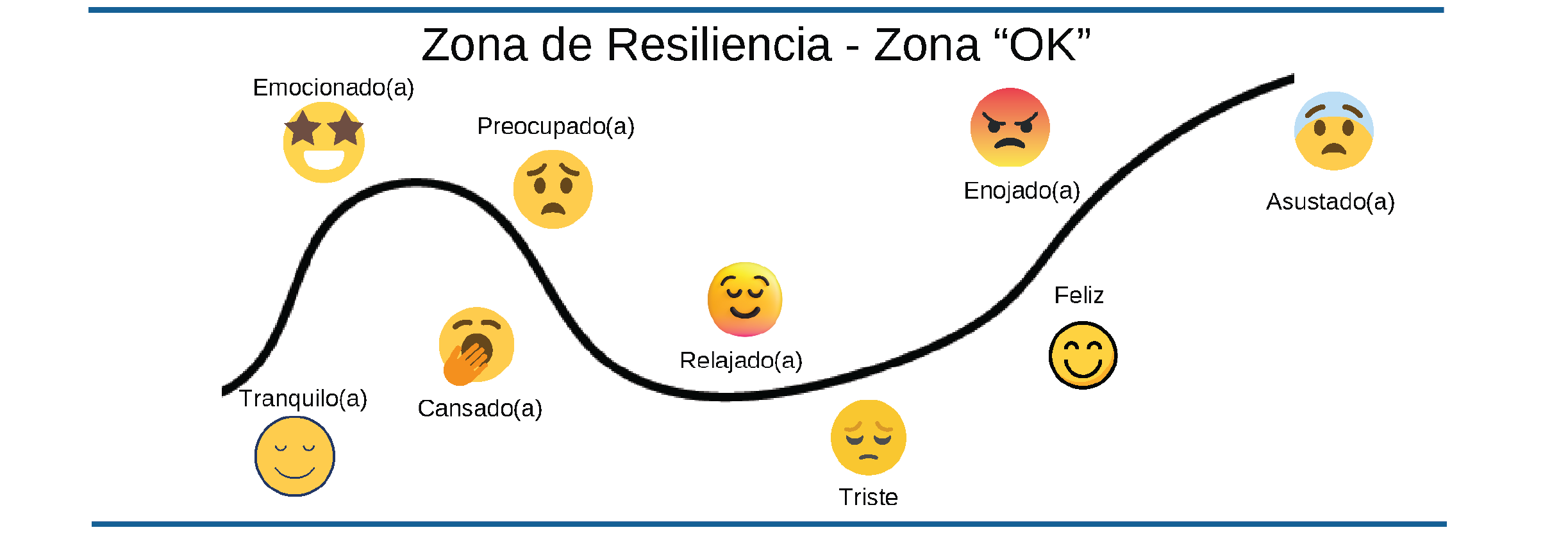
A veces, nos pasan cosas que pueden sacarnos de nuestra zona de resiliencia o zona “OK”. Cuando estamos fuera de esta zona, puede sernos más difícil afrontar o hacer las cosas de la vida. Podemos reaccionar sin pensar antes. También podemos hacer cosas que nos hagan daño a nosotros mismos o a otras personas.
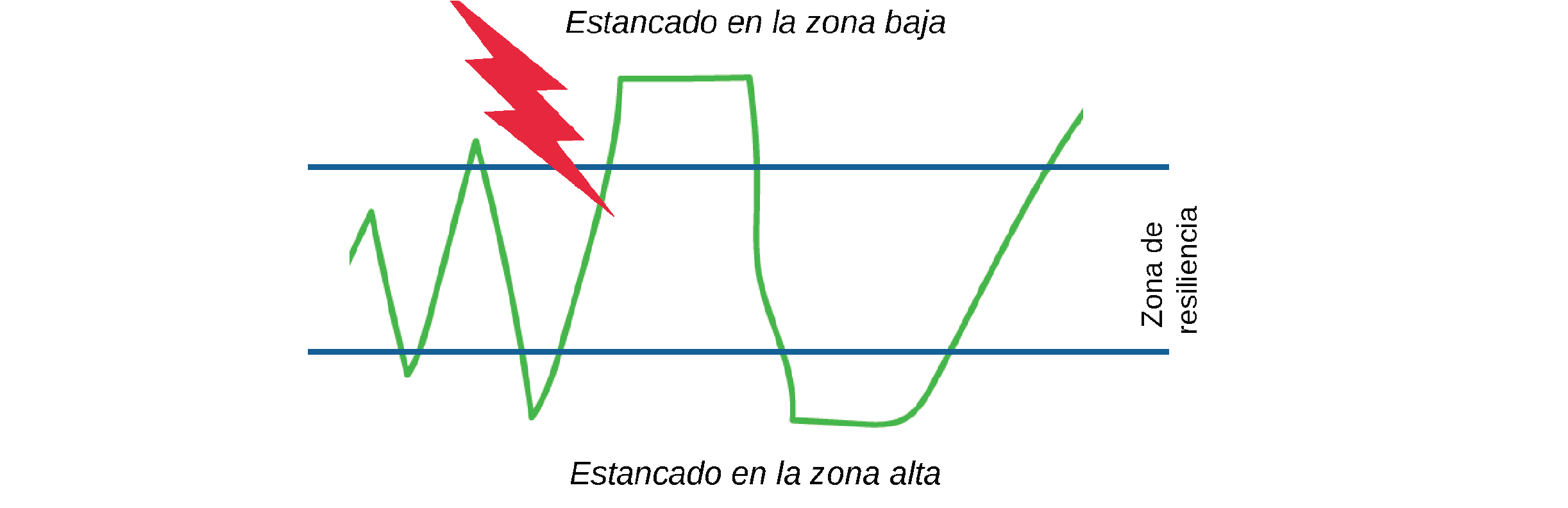
Abajo puedes ver el gráfico de alguien que se sale de su zona de resiliencia. La línea verde representa en qué punto de su zona de resiliencia está esta persona. El relámpago de color rojo es un suceso estresante en su vida. Las líneas azules son los bordes de su zona de resiliencia.
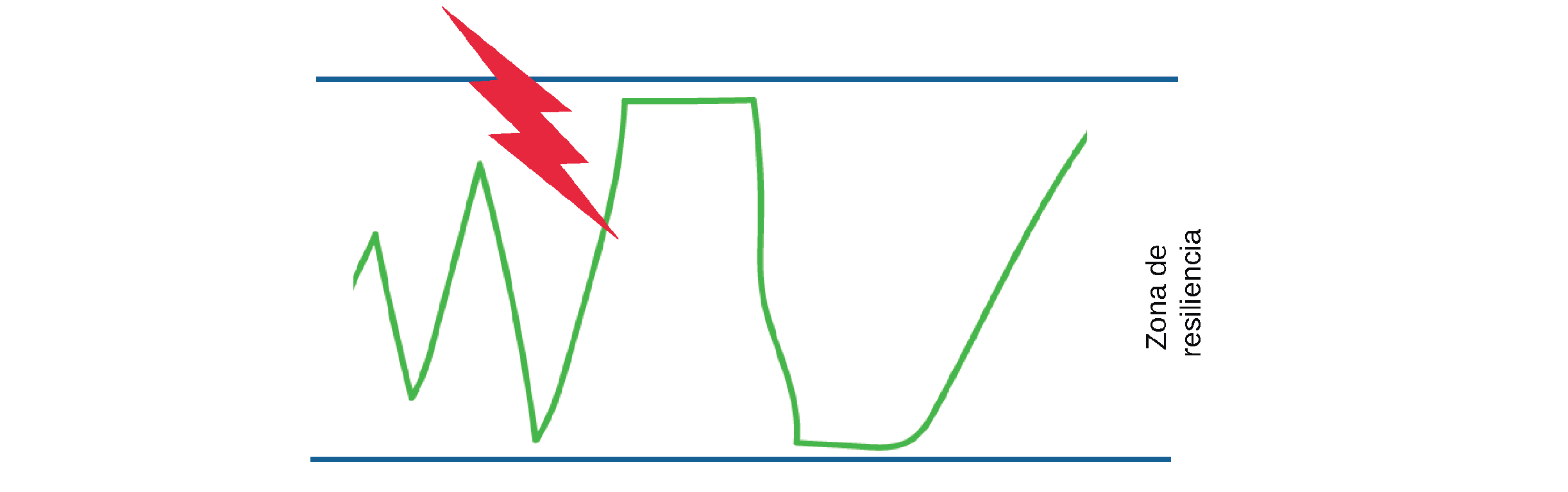
Podemos aprender maneras de hacer que nuestra zona de resiliencia o zona “OK” sea más grande. Cuanto más grande sea nuestra zona, más resilientes somos. Si la persona del ejemplo anterior aumenta su resiliencia y hace que su zona de resiliencia sea más grande, podrá manejar los sucesos estresantes y mantenerse dentro de su zona. Abajo puedes ver el gráfico de la misma persona del ejemplo anterior después de que hizo que su zona de resiliencia fuera más grande.
La zona de resiliencia también se conoce como nuestra “zona OK”. Es la zona donde nos sentimos bien y podemos manejar nuestros pensamientos y sensaciones. Es una estado de bienestar.
Es fácil quedarnos atascados en una de estas zonas y eso puede hacer que nos resulte difícil concentrarnos.

Ientro de la zona de resiliencia
En esta zona, podemos estar tristes, enojados, felices, tranquilos, preocupados o angustiados, todo al mismo tiempo, sin dejar de ser capaces de manejar todos esos sentimientos. Nuestras emociones sencillamente existe en la zona de resiliencia, y no hay una manera correcta o incorrecta de sentir.
Podemos experimentar muchas emociones diferentes positivas o negativas, sin exagerar. Esas emociones están presentes pero es fácil gestionarlas, incluso es fácil ignorarlas.
Fuera de la zona de resiliencia
Nuestras emociones pueden volverse impredecibles. Son abrumadoras y es difícil lidiar con ellas, sin importar qué es lo que estemos sintiendo. No podemos reaccionar bien.
Tay ciertas cosas, como los sucesos o recordatorios traumáticos y estresantes que pueden sacarnos de nuestra “zona OK”.
Cuando nos salimos de nuestra zona de resiliencia, puede resultarnos más difícil lidiar con las cosas y expresarnos. Fuera de esta zona, podemos actuar sin pensar o incluso hacernos daño o hacérselo a otras personas. Controlar nuestros sentimientos se vuelve difícil.
Ampliar nuestra zona de resiliencia es sumamente importante, ya que nos permite sentir y vivenciar en mayor medida sin dejar de estar bien.Cuanto más amplia es nuestra zona, hay más espacio para nuestros pensamientos, sentimientos y reacciones.
Nos volvemos más resilientes cuando ampliamos nuestra zona. Se vuelve más difícil salirnos de la zona y exagerar, y más fácil sentirnos bien durante más tiempo.
This resource, developed by ASERT, provides a visual explanation of what resilience means.
View ResourceThis resource visually explains the concept of the Resilient Zone and managing emotions.
View ResourceThis social story provides information about how to recognize when you are feeling down and recommendations about what you can do to feel better.
View ResourceThis resource visually explains negative emotions that can happen and how to return to the "OK" Zone.
View ResourceThis resource visually explains negative feelings in your body and how to return to the "OK" Zone.
View ResourceMantenerte en tu zona de resiliencia o zona “OK” te ayuda a seguir trabajando en tus objetivos. Pero, ¿ sabes cuándo estás en tu zona de resiliencia o zona “OK”? ¿ Y lo que puedes hacer si te sales de tu zona?
Las habilidades de resiliencia son cosas que puedes hacer y que te ayudan a:
Toma tiempo y práctica aprender a usar es tas habilidades para ser más resiliente. Cuanto más practiques el uso de estas habilidades, más amplia será tu zona de resiliencia y mejor podrás controlar el es trés y las dificultades .
Estas habilidades se pueden usar individualmente o combinadas para ayudarte a mantenerte en tu zona de resiliencia o a regresar a ella. Estas son las distintas habilidades de resiliencia:
Vigilar es una habilidad que te ayuda a no salirte o a regresar a tu zona de resiliencia o zona “OK”. Cuando vigilas, prestas atención a lo que le está pasando a tu mente y tu cuerpo. A veces llamamos “sensaciones” a esos pensamientos y emociones que tenemos en la mente y en el cuerpo.
Nuestro cerebro recibe información a través de muchas vías. Una de estas vías son nuestros sentidos.La información que recibimos a través de los sentidos recibe el nombre de “sensaciones”. Algunos de nuestros sentidos son la vista, el oído, el olfato, el gusto y el tacto. Puedes prestar atención a otras sensaciones, como la respiración, el latido de tu corazón y lo que sientes en el estómago.
Es importante que conozcas las palabras adecuadas para hablar sobre lo que estás pensando y sintiendo. Estas son algunas palabras para describir sensaciones que pueden ayudarte a hablar sobre aquello a lo que estás prestando atención en el interior de tu cuerpo:
Tu cuerpo se puede sentir de manera distinta dependiendo de lo que estés viviendo, pensando o s intiendo.
Algunas cosas hacen que tu cuerpo y tu mente se sientan bien.
Otras cosas pueden hacer que tu cuerpo y tu mente se sientan mal.
A veces , tu cuerpo y tu mente se sienten igual que siempre.
Cuando vigilas cómo se sienten tu cuerpo y tu mente, puedes prestar atención a cuándo tienes sensaciones negativas.
Las sensaciones negativas pueden estar diciéndote que te estás aproximando al borde o incluso que te encuentras fuera de tu zona de resiliencia o zona
“OK”. Puedes usar tus habilidades de resiliencia para que te ayuden a mantenerte en tu zona de resiliencia o zona “OK”. Las sensaciones positivas ,
o las que tienes habitualmente, te confirman que estás en tu zona de resiliencia o zona “OK”.
Cuando conoces la diferencia entre las sensaciones positivas y negativas , puedes elegir a qué prestarle atención en tu cuerpo.
Si le pres tas atención a las sensaciones positivas de tu cuerpo, eso puede ayudarte a permanecer en tu zona de resiliencia o zona “OK” y a sentirte mejor.
La habilidad de vigilar consiste en prestar atención a lo que le está pasando a tu mente y tu cuerpo. Vigilar puede ayudarte a prestar atención a las sensaciones positivas que hay en tu mente o en tu cuerpo para ayudarte a no salirte de tu zona de resiliencia o zona “OK”.
Puede ser difícil prestarle atención a lo que está pasando en tu mente y tu cuerpo. Es importante que hables sobre esas “sensaciones” con personas en las que confías. Ellas podrían enseñarte a prestar atención a las sensaciones, tanto las positivas como las negativas.
Practica describir cómo te sientes y qué sientes contándoselo a otras personas.
Hacerte preguntas también puede ayudarte a prestar atención a lo que estás sintiendo. Algunas preguntas que podrías hacerte son:
Cuando te respondas, presta atención a cada sensación y hazte otra pregunta. ¿Es una sensación positiva o negativa?
No hay respuestas correctas ni incorrectas. Solo tú sabes qué sientes y cómo lo sientes, y si esa sensación es positiva o negativa.
Vigilar es prestar atención a lo que está pasando en tu mente y tu cuerpo. También significa averiguar si esas sensaciones son positivas o negativas.
Rastrear consiste en observar lo que está pasando en tu mente y tu cuerpo. Es una de las habilidades que pueden ayudarte a regresar a tu zona de resiliencia o zona “OK”.
Veamos un ejemplo de los pensamientos y sensaciones que podría tener una persona cuando está usando esta habilidad.
En la imagen, Jack y Jill están teniendo un picnic en el parque después de un paseo en bicicleta. ¿Qué tipos de sensaciones podrían observar si prestan atención?
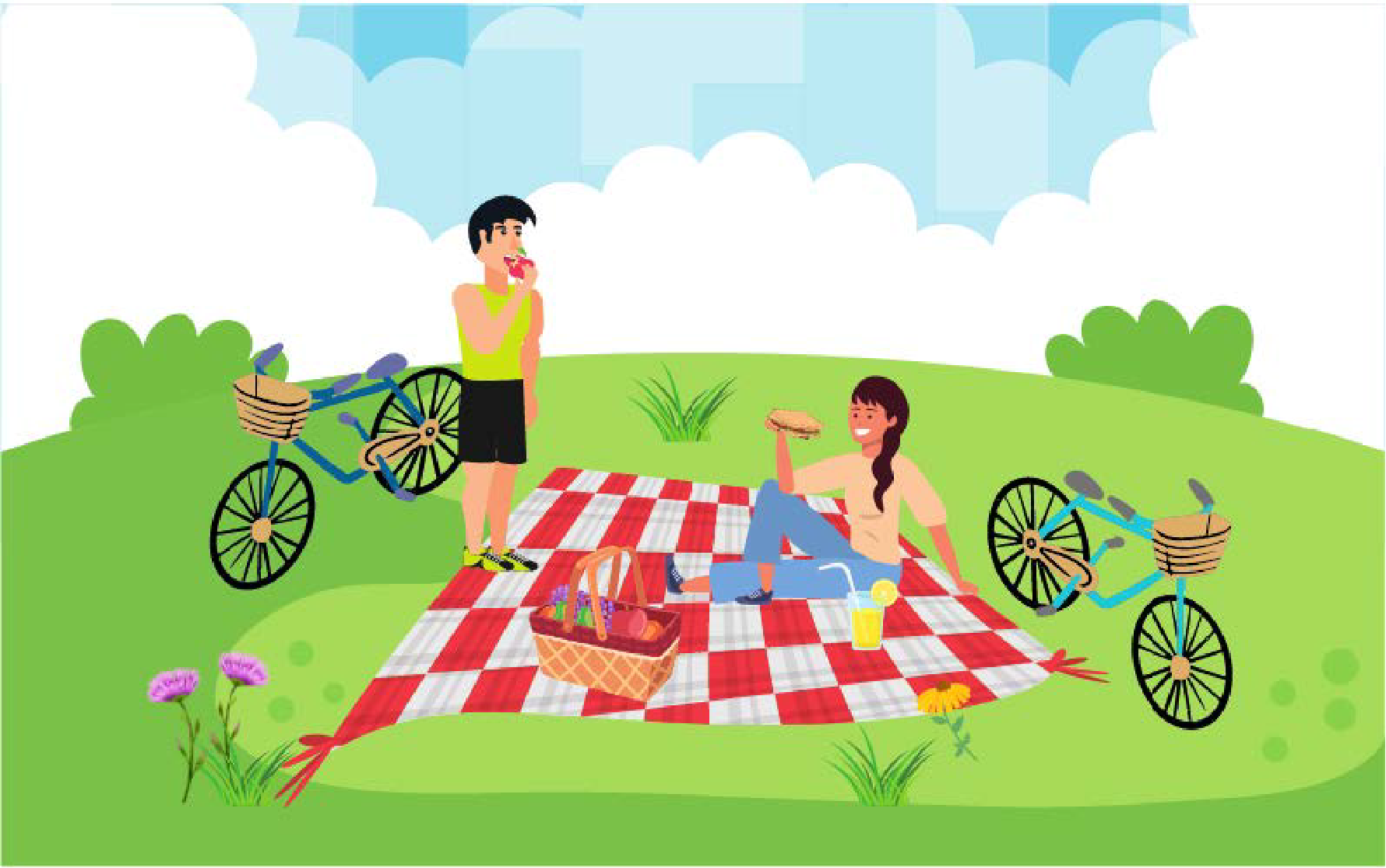
Jack y Jill podrían haber notado estas sensaciones durante el picnic:
Cesta de
picninc
Comida
Manzana dulce
Sándwich
Flores
Hierba
Cobija suave
Brisa fresca
Viento soplando
Pájaros cantando
Rastrear consiste en prestar atención a las sensaciones de tu cuerpo. Los cinco sentidos principales son la vista, el oído, el tacto, el olfato y el gusto. Practicar la habilidad de rastrear puede ayudarte a conocer mejor tu cuerpo y las sensaciones de tu cuerpo. Toda esta práctica puede ayudarte a mantenerte en tu zona de resiliencia o zona “OK”.
¡Es hora de practicar esta habilidad! Utiliza los espacios en blanco a continuación para escribir algunas de las sensaciones que estás teniendo en este momento.
Buscar recursos es una habilidad de resiliencia en la que usas personas, lugares , cosas e ideas para que te ayuden a sentirte mejor.
Buscar recursos puede ayudarte a mantenerte en tu zona de resiliencia o zona “OK”. También puede ayudarte a regresar a tu zona de resiliencia o zona “OK” si te has salido de ella.
Buscar recursos consiste en usar cosas que te gustan para ayudarte a sentirte mejor.
Esas cosas se llaman “recursos”.
Puede ser más fácil si tienes el recurso contigo, pero eso no siempre es posible. Cuando no tienes el recurso a mano, pensar en él puede ser igualmente útil.
Cuando uses la habilidad de buscar recursos, presta atención a los detalles de tu recurso. Hacer eso se denomina INTENSIFICACIÓN DEL RECURSO
Si tienes el recurso contigo, usa tus sentidos para prestar atención a cómo se ve, cómo huele o cómo se siente ese recurso. Si es una imagen de una persona o de un lugar, presta atención a los detalles de la imagen.
Si estás pensando en tu recurso, imagina cómo se ve, cómo se siente, a qué huele, cómo suena y qué te hace sentir.
Cuando uses la habilidad de buscar recursos, trata de prestar atención a al menos tres detalles de tu recurso.
Después de dedicar algún tiempo a pensar en tu recurso, trata de fijarte en qué partes del cuerpo sientes que se han calmado o incluso se sienten “bien”.
Presta atención a tu respiración, ritmo cardíaco y músculos. Después de pensar en tu recurso, es posible
que sientas que tu respiración y tu ritmo cardíaco son más lentos y tus músculos están más relajados.
“Buscar recursos” es el nombre de una habilidad que incluye el uso de recursos. Un recurso puede ser cualquier cosa que te ayuda a sentirte mejor. Puede ser una persona, un lugar, un objeto, una idea o cualquier otra cosa que te ayude a sentirte mejor.
Jack le cuenta a Jill que su mamá le enseñó a tomar fotos. Jill le hace preguntas sobre su mamá y sobre qué le gusta de tomar fotos.
Jack le responde que le gusta tomar fotos con su mamá al aire libre y el tiempo que pasan juntos. Le dice que su mamá es divertida y le hace reír. Jack sonríe cuando le habla a Jill sobre su mamá.
La mamá de Jack es un recurso para él. Incluso cuando no está con su mamá, puede pensar en ella y eso puede ayudarle a sentirse mejor.
Jack puede practicar hacer el recurso más intenso tratando de recordar detalles específicos de su mamá.
Piensa en uno de tus propios recursos. Recuerda que un recurso puede ser cualquier persona o cualquier cosa que te resulte tranquilizadora (una persona, un lugar, un objeto, una idea, etc.). Escribe tu respuesta en el espacio de abajo.
Por ejemplo:
Una persona podría escoger a su viejo oso de peluche como su recurso favorito.
Cómo intensificar el recurso: Piensa en algunos detalles de tu recurso y escríbelos.
Por ejemplo:
El oso de peluche puede ser grande, suave, peludo, y de color
marrón claro y los ojos negros.
¿Qué partes del cuerpo “se tranquilizan” o “se sienten bien” cuando piensas en tu recurso?
Por ejemplo:
Los hombros y el pecho podrían comenzar a relajarse.
Reconectar con la realidad es una manera de concentrarse en las cosas que están pasando en ese mismo momento. Una de las formas más sencillas de hacer esto es prestar atención a las sensaciones de tu cuerpo. Así puedes usar esa información para ayudarte a colocar tu cuerpo en una posición más cómoda.
Vigilar: Solo observas o reúnes información | Te enfocas en tus sensaciones y pensamientos.
Reconectar con la realidad: Utilizas la información para sentirte más cómodo(a). | Te enfocas en las sensaciones únicamente.
Los gestos pueden ser movimientos que transmiten lo que estamos pensando o sintiendo. Los gestos pueden demostrar que estamos enojados, felices o tristes, entre otros sentimientos.
Usamos gestos todos los días, a veces incluso sin pensarlo. Cuando nos salimos de nuestra zona de resiliencia o zona “OK”, podemos usar gestos que nos ayuden a mantenernos en nuestra zona.
Al escoger y usar gestos que nos ayudan a sentirnos tranquilos, felices o relajados, podemos cambiar los pensamientos que estamos teniendo y que nos están sacando de nuestra zona “OK”.
Hacer gestos que nos hacen sentir tranquilos, felices o relajados puede hacer que nuestro cerebro recuerde momentos en los que nos hemos sentido así. ¡Podemos usar nuestros cuerpos para cambiar nuestros pensamientos!
Estos son algunos ejemplos de gestos que pueden hacer que nos sintamos tranquilos, relajados o felices:
Los gestos pueden ser movimientos grandes, que se hacen con todo el cuerpo, o movimientos pequeños y sencillos.
Cada quien tiene sus propios gestos. Es importante que averigües cuáles son los gestos que te funcionan a ti.
Es posible que ya hagas gestos que te ayudan a sentirte tranquilo(a), feliz o relajado(a) y ni siquiera te hayas dado cuenta. Si no sabes qué gestos usar, puedes probar a hacer distintos gestos o preguntarle a alguien que te conoce bien si ha visto que tú hagas algo que parezca ayudarte a relajarte.
Los gestos pueden ser movimientos que transmiten lo que estamos pensando o sintiendo. Los gestos pueden demostrar que estamos enojados, felices o tristes, entre otros sentimientos.
Al escoger y usar gestos que nos ayudan a sentirnos tranquilos, felices o relajados, podemos cambiar los pensamientos que estamos teniendo y que nos están sacando de nuestra zona “OK”.
Es útil que practiques hacer gestos para que, cuando te enfrentes a un desafío, puedas usarlos fácilmente para que te ayuden a mantenerte dentro de tu zona de resiliencia o zona “OK”.
Utiliza el espacio de abajo para escribir algunos gestos o movimientos que haces cuando te sientes tranquilo(a), feliz o relajado(a). Si no sabes qué escribir, pídele a alguien que te conoce bien que te ayude a pensar en ideas.
Usando las respuestas que escribiste arriba, dedica unos minutos a practicar esos movimientos. Cuando hayas terminado, observa cómo te sientes. ¿Alguna parte de tu cuerpo se siente diferente o más relajada? Autodefensores
Sigue practicando estos gestos o movimientos en distintos momentos del día. De esta manera, te será más fácil usar esta habilidad cuando sientas que te estás saliendo de tu zona de resiliencia o zona “OK”.
Cambiar de pensamiento y mantenerlo es una habilidad que puedes usar para cambiar tus pensamientos y regresar a tu zona de resiliencia.
Para cambiar de pensamiento y mantenerlo, tienes que usar también las otras habilidades: vigilar, buscar recursos, reconectar con la realidad y hacer gestos. Usar esas otras habilidades primero te ayuda a encontrar pensamientos más reconfortantes. ¡Hagamos un repaso!
Si estás pensando en algo que te provoca incomodidad o que te es difícil, CAMBIA esos pensamientos negativos por otros que sean positivos. Encuentra algo que te haga sentir bien o feliz cuando lo piensas. Tal vez necesites practicar las otras habilidades de resiliencia para encontrar pensamientos que te calmen más, con los que te sientas más cómodo(a) o más tranquilo(a).
Después, MANTÉN tu atención centrada en esos pensamientos positivos. Haz esto hasta que te sientas mejor y estés preparado(a) para pasar a otra cosa.
No es nada malo que una habilidad no te funcione la primera vez que intentes ponerla en práctica. A veces, necesitamos probar varias habilidades para calmarnos. A veces, necesitamos practicar las habilidades varias veces para calmarnos. Lo importante es seguir usándolas hasta que regreses a tu zona de resiliencia.
Cambiar de pensamiento y mantenerlo es una habilidad de resiliencia que hay que usar junto con otras habilidades (vigilar, buscar recursos, reconectar con la realidad y hacer gestos) para que funcione.
CAMBIA tus pensamientos negativos por otros que sean positivos. Utiliza las otras habilidades para encontrar algo que te haga sentir feliz, en calma o relajado(a). MANTÉN tu atención centrada en esos pensamientos positivos.
Practicar esta habilidad es útil porque puedes usarla cuando enfrentes dificultades para regresar a tu zona de resiliencia. Además, te permite practicar al mismo tiempo las otras habilidades.
PRÁCTICA:
Practica usar cada una de estas habilidades para CAMBIAR el foco de tu atención y fijarla en algo “positivo” o placentero, y después trata de MANTENER esos pensamientos al menos dos minutos.
VIGILAR: Escribe las sensaciones que observas a tu alrededor en este momento (qué puedes ver, oír, oler, tocar o saborear).
BUSCAR RECURSOS: Encuentra un recurso (p. ej.; un peluche). Escribe los detalles que observas en ese recurso.
RECONECTAR CON LA REALIDAD: Vuelve a fijarte en las sensaciones que escribiste cuando estabas vigilando. Concéntrate en cualquier cosa que te parezca negativa o incómoda en este momento. Mueve tu cuerpo hasta que cambies lo que sientes y estés a gusto.
HACER GESTOS: Piensa en gestos que te hagan sentir mejor. Realiza esos movimientos hasta qu comiences a sentirte de otra manera o mejor.
Después de completar esta actividad, tómate un minuto para pensar en cómo te sentiste poniendo en práctica cada habilidad. ¿Cuál de ellas fue la más útil? Sigue practicando las habilidades para que puedas controlar mejor tus pensamientos y tu cuerpo.
Ayuda Ahora es una habilidad que puedes usar si te sientes abrumado(a) y no puedes volver a tu zona de resiliencia o zona “OK”.
Esta habilidad consiste en varias estrategias distintas, las cuales se centran en tu cuerpo en vez de tus pensamientos.
A medida que tu cuerpo se relaja, puedes continuar usando esta habilidad o cambiarla por alguna de las otras habilidades de resiliencia.
Prueba algunas de estas estrategias de “¡Ayuda ahora!” por ti mismo(a). Presta atención a cómo sientes tu cuerpo antes, durante y después de poner en práctica cada estrategia.
Algunas de ellas te van funcionar mejor que otras. Pruébalas en diferentes momentos para saber cuáles te gustan más. Haz una marca al lado de las técnicas que funcionan mejor para ti.
Cuando sepas qué destrezas son las que funcionan mejor para ti, practícalas a lo largo del día para que puedas usarlas más fácilmente cuando salgas de tu zona de resiliencia o zona “OK”.
This resource visually explains Tracking, a technique used to pay closer attention to thoughts and feelings.
View ResourceThis social story helps explain the idea of Shift and Stay, which helps change thoughts to stay in the Resilient Zone.
View ResourceThis resource visually explains the skill called Help Now, which uses strategies to help calm down.
View ResourceThis resource provides a visual explanation of Grounding, which is paying attention to the environment to help improve emotions and stay calm.
View ResourceThis resource visually explains Gesturing, which is using movements to help improve mood.
View ResourceThis social story explains the concept of Resourcing to use people, places, things, and ideas to feel better.
View ResourceUna persona tiene una crisis de salud mental cuando sus problemas o sensaciones son tan fuertes que no sabe qué tiene que hacer ese día.
También puede significar que esa persona corre el riesgo de hacerse daño o hacer daño a otros.
Estas son algunas señales comunes que indican que una persona podría estar teniendo una crisis mental:
A veces, una crisis dura apenas unos pocos minutos.
A veces, una crisis puede durar días o meses.
Eso depende de la rapidez con que la persona pueda recibir ayuda y el tipo de habilidades de afrontamiento que ella tenga.
Si una persona es capaz de ampliar su zona de resiliencia o zona “OK”, podrá recuperarse más rápidamente de una crisis de salud mental.
Nuestras mentes funcionan mejor cuando estamos tranquilos y felices .
Si llegamos al límite de nuestra zona de resiliencia o zona “OK ”, nuestras mentes no funcionan tan bien.
Un plan de resiliencia o de cuidado personal puede ayudarte a practicar las habilidades de resiliencia para que puedas usarlas fácilmente si te llevan al límite.
Cuando estás fuera de tu zona de resiliencia o zona “OK ”, puede resultarte muy difícil decidir qué haceren ese momento.
Si te sacan de tu zona de resiliencia o zona “OK ”, puedes s implemente hacer lo que esté en tu plan.
| Name | Description | Type | File |
|---|---|---|---|
| Tipos de traumas | Los traumas y eventos traumáticos pueden producirse de muchas maneras diferentes . Abajo se presentan algunas definiciones y ejemplos de cómo pueden ocurrir los traumas . | Download file: Tipos de traumas | |
| ¿Qué es un Trauma? | Un trauma es un suceso o evento que ocurre y puede afectar a las personas de diferentes maneras. | Download file: ¿Qué es un Trauma? | |
| ¿ Cómo se manifies ta el trauma? | Las personas sienten y afrontan los traumas de manera diferente. | Download file: ¿ Cómo se manifies ta el trauma? | |
| Estrés Traumático | Cuando alguien experimenta un trauma, puede provocarle estrés traumático. | Download file: Estrés Traumático | |
| Circuito de Sobrevivencia | El circuito de sobrevivencia es cómo responden nuestro cuerpo y nuestrocerebro a las amenazas que nos rodean. | Download file: Circuito de Sobrevivencia | |
| El estrés postraumático y elcircuito de sobrevivencia | El circuito de sobrevivencia es cómo responden nuestro cuerpo y nuestrocerebro a las amenazas que nos rodean. Los traumas pueden modicar laforma en que funciona el circuito de sobrevivencia en nuestro cerebro. | Download file: El estrés postraumático y elcircuito de sobrevivencia | |
| Las Cuatro "F" | Cuando tu cerebro cree que existe una amenaza, tu cuerpo puede reaccionar de varias anerasdistintas. Estas reacciones a veces se denominan “las 4 F”, porque en inglés todas comienzancon esa letra y así es más fácil recordarlas. | Download file: Las Cuatro "F" | |
| Introducción a la Resiliencia | La resiliencia se puede explicar de muchas maneras distintas. También puede significar distintas cosas. ¡Todas las personas tienen resiliencia! | Download file: Introducción a la Resiliencia | |
| ¿Por qué es importante la resiliencia? | La resiliencia hace que las personas sean flexibles cuando les pasa algo. Les permite pensar en lo que les sucedió y aprender cómo cambiar, responder y sanar. | Download file: ¿Por qué es importante la resiliencia? | |
| Emociones Dentro y Fuera de la Zona de Resiliencia: Cómo Aprender a Ampliarla | La zona de resiliencia también se conoce como nuestra “zona OK”. Es la zona donde nos sentimos bien y podemos manejar nuestros pensamientos y sensaciones. Es una estado de bienestar. | Download file: Emociones Dentro y Fuera de la Zona de Resiliencia: Cómo Aprender a Ampliarla | |
| Sensibilidad a los Traumas y la Resiliencia | Las personas sensibles a los traumas entienden que el trauma puede afectar a la gente de muchas maneras distintas. | Download file: Sensibilidad a los Traumas y la Resiliencia | |
| Introducción a las Habilidades de Resiliencia | Mantenerte en tu zona de resiliencia o zona “OK” te ayuda a seguir trabajando en tus objetivos. Pero, ¿ sabes cuándo es tás en tu zona de resiliencia o zona “OK”? | Download file: Introducción a las Habilidades de Resiliencia | |
| ¿Qué es Vigilar? | Vigilar es una habilidad que te ayuda a no salirte o a regresar a tu zona de resiliencia o zona “OK”. Cuando vigilas, prestas atención a lo que le está pasando a tu mente y tu cuerpo. | Download file: ¿Qué es Vigilar? | |
| ¿ Por qué es importante la habilidad de vigilar? | Tu cuerpo se puede sentir de manera distinta dependiendo delo que estés viviendo, pensando o sintiendo. | Download file: ¿ Por qué es importante la habilidad de vigilar? | |
| Aprende a vigilar | Puede ser difícil prestarle atención a lo que está pasando en tu mente y tu cuerpo. Es importante que hables sobre esas “sensaciones” con personas en las que confías. Ellas podrían enseñarte a prestar atención a las sensaciones, tanto las positivas como las negativas. | Download file: Aprende a vigilar | |
| Práctica: Rastrear | Tracking is when you notice what is happening inside your mind and body. It is one of the skills that can help you get back to your Resilient Zone or “OK" Zone. | Download file: Práctica: Rastrear | |
| ¿ Qué es Buscar Recursos ? | Buscar recursos es una habilidad de resiliencia en la que usas personas , lugares , cosas e ideas para que te ayuden a sentirte mejor. | Download file: ¿ Qué es Buscar Recursos ? | |
| Práctica: Buscar Recursos | “Buscar recursos” es el nombre de una habilidad que incluye el uso de recursos. Un recurso puede ser cualquier cosa que te ayuda a sentirte mejor. | Download file: Práctica: Buscar Recursos | |
| Reconectar con la Realidad | Reconectar con la realidad es una manera de concentrarse en las cosas que están pasando en ese mismo momento. | Download file: Reconectar con la Realidad | |
| Práctica para autodefensores: | Reconectar con la realidad es una manera de concentrarse en las cosas que están pasando en ese mismo momento. Una de las formas más sencillas de hacer esto es prestar atención a las sensaciones de tu cuerpo. | Download file: Práctica para autodefensores: | |
| Hacer Gestos | Los gestos pueden ser movimientos que transmiten lo que estamos pensando o sintiendo. Los gestos pueden demostrar que estamos enojados, felices o tristes, entre otros sentimientos. | Download file: Hacer Gestos | |
| Practica: Hacer Gestos | Al escoger y usar gestos que nos ayudan a sentirnos tranquilos, felices o relajados, podemos cambiar los pensamientos que estamos teniendo y que nos están sacando de nuestra zona “OK”. | Download file: Practica: Hacer Gestos | |
| ¿Que Es Cambiar De Pensamiento Y Mantenerlo? | Para cambiar de pensamiento y mantenerlo, tienes que usar también las otras habilidades: vigilar, buscar recursos, reconectar con la realidad y hacer gestos. | Download file: ¿Que Es Cambiar De Pensamiento Y Mantenerlo? | |
| Practica: Cambiar De Pensamiento Y Mantenerlo | CAMBIA tus pensamientos negativos por otros que sean positivos. Utiliza las otras habilidades para encontrar algo que te haga sentir feliz, en calma o relajado(a). MANTÉN tu atención centrada en esos pensamientos positivos. | Download file: Practica: Cambiar De Pensamiento Y Mantenerlo | |
| ¡Ayuda Ahor A! | Ayuda Ahora es una habilidad que puedes usar cuando te sientes abrumado(a). Cuando enfrentas una gran cantidad de cambios, puede ser difícil mantenerte en tu zona de resiliencia o zona “OK”. | Download file: ¡Ayuda Ahor A! | |
| Ayuda Ahora Práctica | Ayuda Ahora es una habilidad que puedes usar si te sientes abrumado(a) y no puedes volver a tu zona de resiliencia o zona “OK”. | Download file: Ayuda Ahora Práctica | |
| Perspectiva General De Las Habilidades De Resiliencia | La habilidad de vigilar utiliza tus sentidos para prestar atención a tus pens amientos , sentimientos y las sensaclones de tu cuerpo | Download file: Perspectiva General De Las Habilidades De Resiliencia | |
| Cómo reconocer una crisis de salud mental | Una persona tiene una crisis de salud mental cuando sus problemas o sensaciones son tan fuertes que no sabe qué tiene que hacer ese día. | Download file: Cómo reconocer una crisis de salud mental | |
| Cómo manejar una crisis de salud mental | Tener un plan puede ayudarte a superar una crisis de salud mental más fácilmente o incluso prevenir que suceda. | Download file: Cómo manejar una crisis de salud mental | |
| Cómo crear un plan de resiliencia o de cuidado personal | Un plan de resiliencia o de cuidado personal puede ayudarte a practicar las habilidades de resiliencia para que puedas usarlas fácilmente si te llevan al límite. | Download file: Cómo crear un plan de resiliencia o de cuidado personal | |
| Mi Plan Para Ser Resiliente | Esta plantilla te ayudará a desarrollar un plan de resiliencia. | Download file: Mi Plan Para Ser Resiliente | |
| La Zona de Resiliencia | La zona de resiliencia es donde estamos cuando podemos manejar nuestras sensaciones y pensamientos. La zona de resiliencia también se puede llamar zona “OK.” | Download file: La Zona de Resiliencia |
This information was developed by the Autism Services, Education, Resources, and Training Collaborative (ASERT). For more information, please contact ASERT at 877-231-4244 or info@PAautism.org. ASERT is funded by the Bureau of Supports for Autism and Special Populations, PA Department of Human Services.